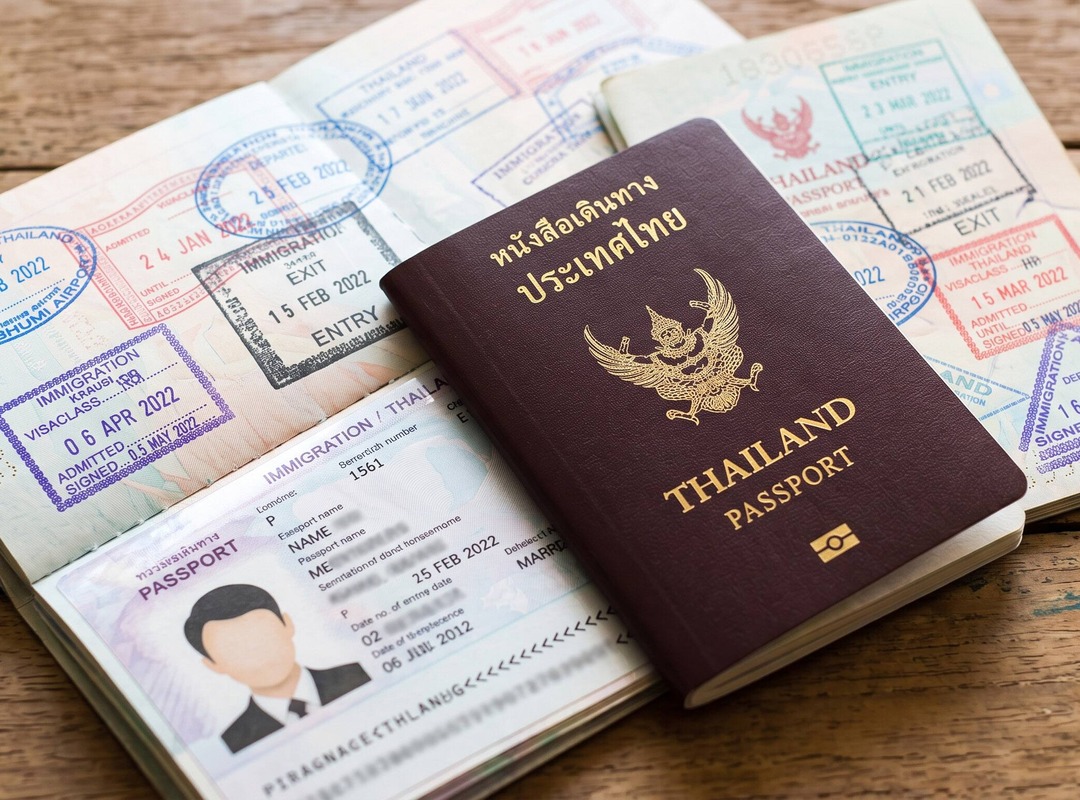
Most travellers who are refused entry to Thailand are not unwelcome. They are missing one of three things: a passport with too little validity left, a Thailand Digital Arrival Card (TDAC) that was never filed, or proof of an onward flight and a place to stay. Every one of those can be fixed in the 24 hours before you fly.
This is your before you fly Thailand checklist—Thailand entry requirements in the order you will actually need them: visa rules, passport standards, the free official TDAC Thailand form, documents immigration may ask for, customs basics, and a 48-hour countdown.
For the trip itself—where to go, how many days, which coast—use How to Plan a Trip to Thailand in 2027: 7 Easy Steps. This page is paperwork only.
1. Visa Exemption Is Not “No Paperwork”
Thailand visa exemption lets eligible visitors from China, the United States, the UK, much of the EU, Australia, Canada and many other countries enter without applying for a tourist visa in advance. That removes the embassy queue. It does not remove the Thailand arrival card (now digital), onward-travel checks, or a spot check at the border.
One change that matters for longer trips. From 15 September 2026, Thailand revised its unilateral tourist visa exemption schemes. For most nationalities admitted under the updated tourism exemption, the permitted stay is commonly discussed as up to 30 days—not the former 60-day window. Confirm your nationality on the official lists before you book a long stay:
- MFA Consular Affairs summary (effective 15 September 2026): consular.mfa.go.th — visa exemption & VoA schemes
- Country lists (ผ.30, VoA, bilateral, ผ.15): consular.mfa.go.th — public service lists
Chinese nationals often enter visa-free under the mutual exemption arrangements in force since March 2024—typically discussed as up to 30 days per entry, with an overall limit sometimes summarised as no more than 90 days in any 180-day period. Treat embassy and MFA pages as authoritative for your passport; rules can be refined without a travel blog noticing.
What that means in practice:
- A 5–14 day Thailand holiday: the shortened window rarely changes your plan.
- A 45–60 day stay: you generally need the right Thai visa before departure, not a hope that exemption will stretch.
- Exemption is for tourism, visiting family, and short business visits. Working, teaching, paid tours or commercial shoots on an exempt entry is not permitted and can end in removal and an entry ban.
Need a visa? Apply only on the official portal: Thai e-Visa — www.thaievisa.go.th. Cross-check with your local Royal Thai Embassy; a clear English example of exemption bands and TDAC is Royal Thai Embassy, Doha — Tourist Visa Exemption & Visa-on-Arrival.
2. Passport: Three Hard Requirements
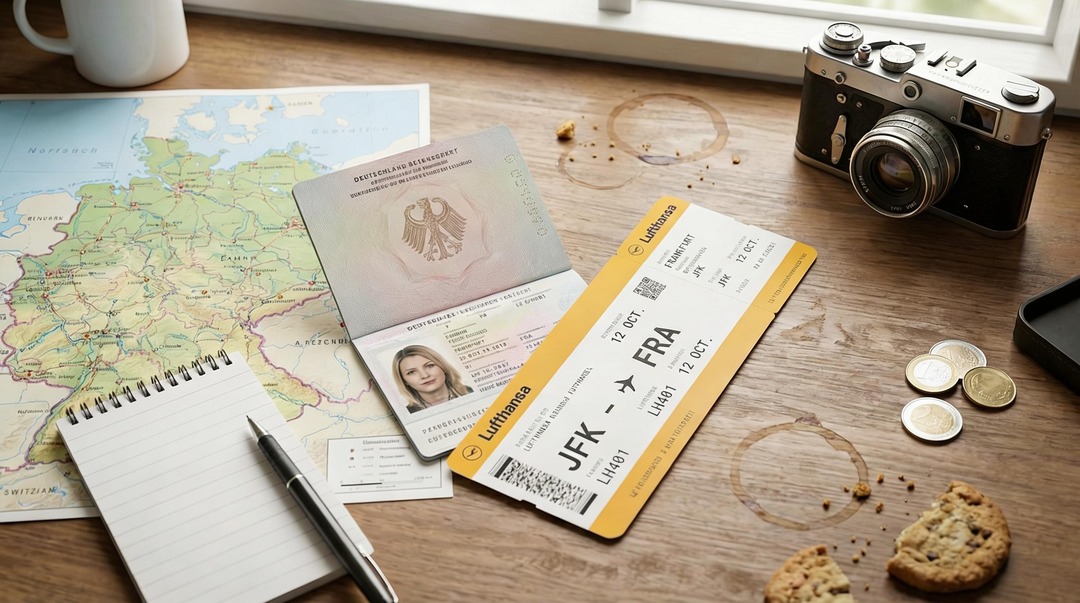
Airline check-in staff and Thai immigration apply the same practical standard for passport validity Thailand checks:
- At least six months’ validity remaining — counted from the date you arrive in Thailand, not the day you leave home.
- At least two consecutive blank visa pages for the entry stamp (airlines enforce this more often than travellers expect).
- Good physical condition — no water damage, tears, loose covers, alterations, stickers or unofficial markings.
The third point is why a growing number of travellers are turned away at Phuket Airport (HKT) and Suvarnabhumi (BKK). A peeling cover or a child’s drawings in the memo pages can be treated as a damaged passport. Check every page before you book non-refundable tickets; renewing early costs less than being refused boarding.
Two details worth noting:
- Renewed your passport recently? Carry both booklets if the old one still holds previous Thai entry and exit stamps that matter to your history.
- Travelling with children: every child needs their own passport, regardless of age. Visa exemption and TDAC are applied per person.
3. The TDAC: Free, Official, Filed Within 72 Hours
Since 1 May 2025, the Thailand Digital Arrival Card (TDAC) has fully replaced the paper TM6 arrival card. Every non-Thai traveller completes it online—whether you arrive by air, land or sea. It is not a visa. Visa-exempt guests, e-Visa holders and Visa-on-Arrival travellers still file it.
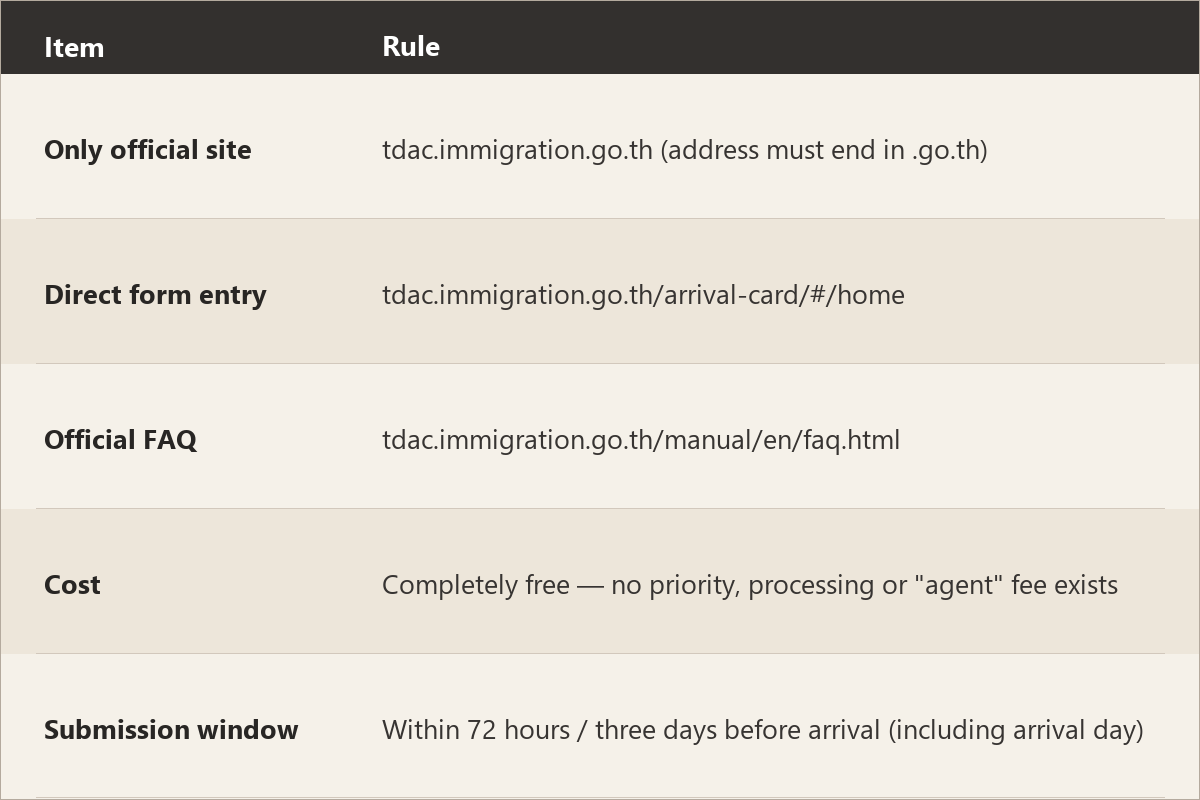
Any “expedited TDAC” or agent site ending in .com or .net is either reselling a free service or harvesting your data. Thailand’s Ministry of Tourism and Sports has warned about fake paid TDAC websites: mots.go.th warning. The real form takes a few minutes on your own.
Have these ready
- Passport bio page: name exactly as printed, passport number, issue and expiry dates
- Flight details: number with airline code (e.g. TG615), arrival date, port of entry
- Hotel confirmation in English: name, address, postcode if shown, and a +66 phone number—or your host’s real address if staying with friends
- An email inbox you can open on arrival (confirmation and QR-coded PDF go there)
Six steps, start to finish
- Open tdac.immigration.go.th and start a new declaration. Chinese and English interfaces are both available; companions can share one family submission (FAQ: up to 10 entries).
- Enter your name exactly as printed in your passport. First name = given name; last name = family name—this is the single most common error for many Asian travellers.
- Enter date of birth as DD/MM/YYYY.
- Copy passport number, issue and expiry carefully—typos here force a whole new declaration.
- Add arrival flight, port of entry (BKK Suvarnabhumi, DMK Don Mueang, HKT Phuket, CNX Chiang Mai), length of stay and departure date. The departure date must fall inside your permitted stay.
- Paste accommodation details in English, check the email character by character, submit, then screenshot the QR code into your photo album and email a copy to yourself.
Corrections: routine details such as hotel or flight can often be fixed by updating or resubmitting before arrival. Name, passport number and date of birth cannot be casually edited—if one is wrong, file a new TDAC. Check those three twice.
Two questions we hear constantly
- Transiting without clearing immigration? No TDAC needed. The moment you enter Thailand—including a land border from Laos or Malaysia—you need one (FAQ).
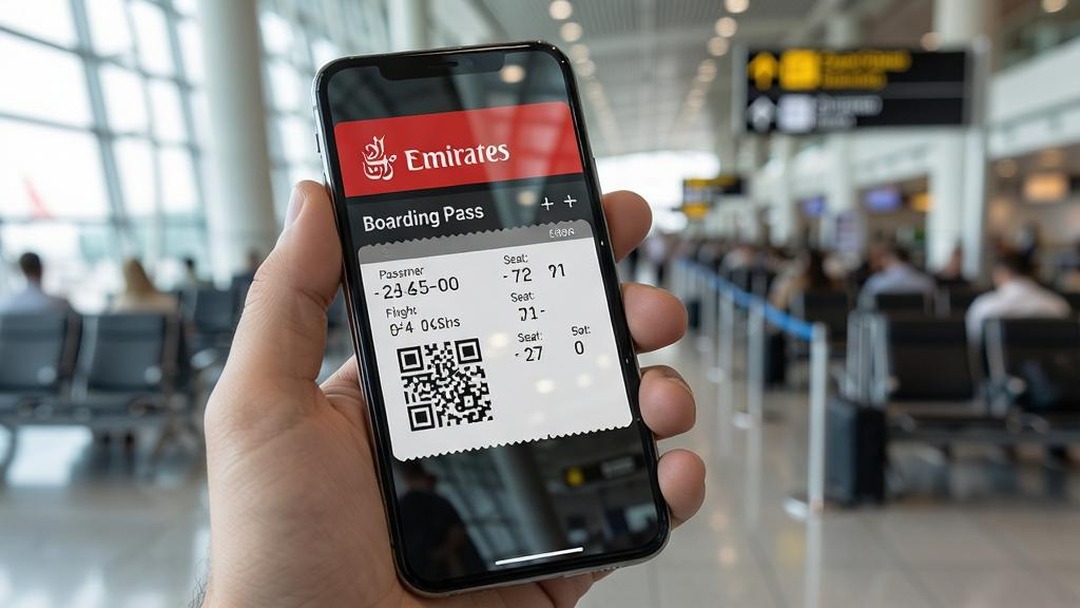
- No signal on landing? That is why the screenshot matters. Immigration at major airports scans the QR from your phone; printing is optional, but a dead phone after a long-haul flight is common.
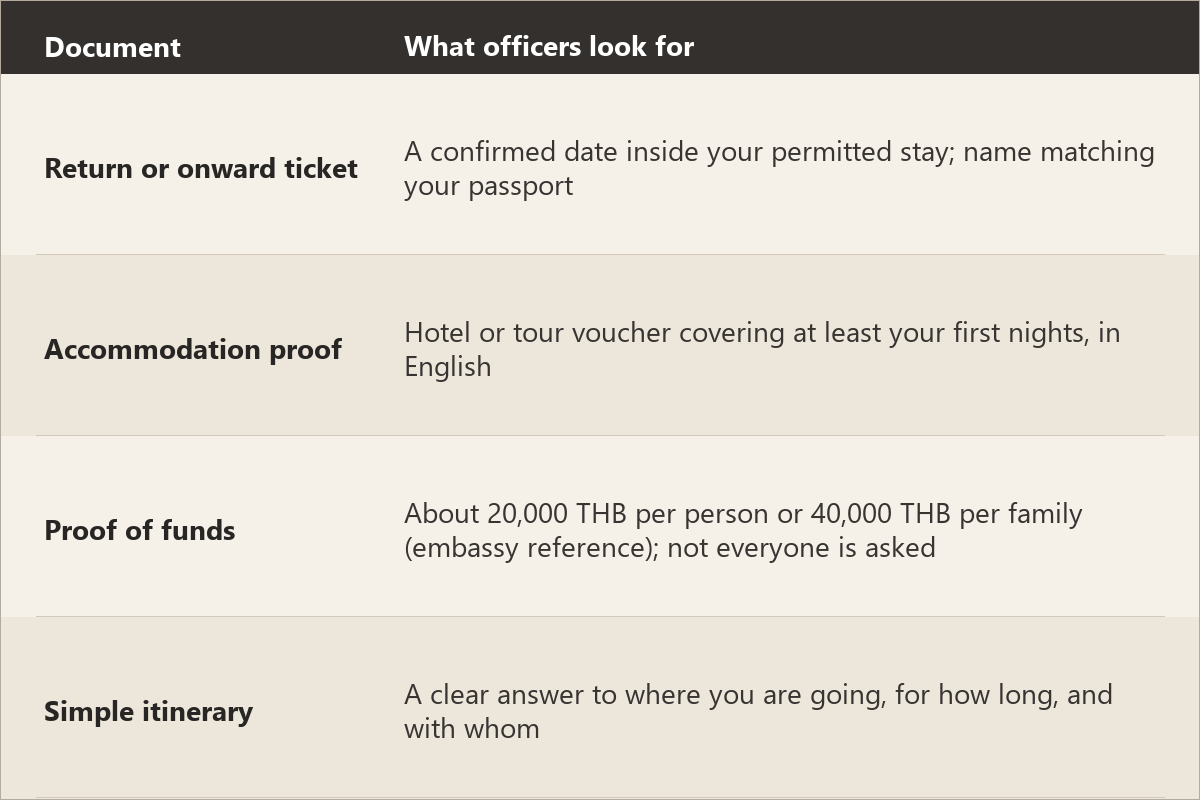
4. Four Documents Officers May Ask to See
The spot-check list is not printed on a giant sign, but these items appear again and again in Thailand immigration documents refusals. Keep them in the same folder as your passport:
The same logic applies to back-to-back “visa runs.” Re-entering immediately after a permitted stay expires is often treated as anything but ordinary tourism.
Carry some Thai baht in banknotes for the first days. Card balances and app wallets are useful in malls; they are a weaker answer if an officer asks to see cash on the spot. Exchange at the airport if you need to.
5. Customs: Allowances and Outright Bans
After you land: immigration (including biometrics where required), baggage claim, then the green channel if you have nothing to declare or the red channel if you do. Confirm current limits with Thai Customs before you pack.
Typical points travellers ask about:
- Duty-free style allowances often discussed for personal use: cigarettes and a limited amount of alcohol—declare anything above the published limit.
- Prohibited for most visitors: electronic cigarettes, pods, vapes and e-liquid (a common cause of fines—leave them at home), many meat products, fresh fruit and vegetables, imitation firearms, and prohibited media.
- Cash declaration: large amounts of currency (commonly discussed around the equivalent of 200,000 THB) must be declared under customs rules—check the current threshold on the Customs site.
- No photography or video in restricted immigration and customs areas, including a casual shot of your passport and stamp. Phones up in the wrong zone have caused real trouble.
Immigration Bureau home: www.immigration.go.th.
6. Six Things People Forget
- Travel insurance is not usually a formal condition of entry, but private hospitals bill visitors at visitor rates. Choose medical cover plus evacuation, and keep the PDF and 24-hour assistance line on your phone.
- Driving and scooters. Renting in Thailand generally requires an International Driving Permit (1968 Convention) with the right category—including motorcycle if you ride. A home licence alone is often not enough, and riding without proper documents can void insurance. For a first trip, a private car with a driver is the calmer default.
- Yellow fever certificate only if you arrive from (or transit) a listed endemic country within the period health rules require—not a routine ask for travellers coming only from China, North America or Europe. Confirm with your airline and health authority if your routing is complex.
- Connectivity and payment. Install an eSIM before departure or buy a local SIM at the airport. Cards work in malls and convenience stores; many street stalls, tuk-tuks and island shops remain cash only.
- Numbers to save: Police 191; Tourist Police 1155 (English available). Chinese nationals can also use consular protection channels published by the Chinese Embassy in Thailand and the MFA global hotline +86-10-12308.
- Check the stamp. Confirm the permitted-stay date on your entry stamp. Overstay is commonly fined about 500 THB per day (with a published cap often cited around 20,000 THB), and a long overstay can trigger a re-entry ban—verify current fines with Immigration before you push a departure date.
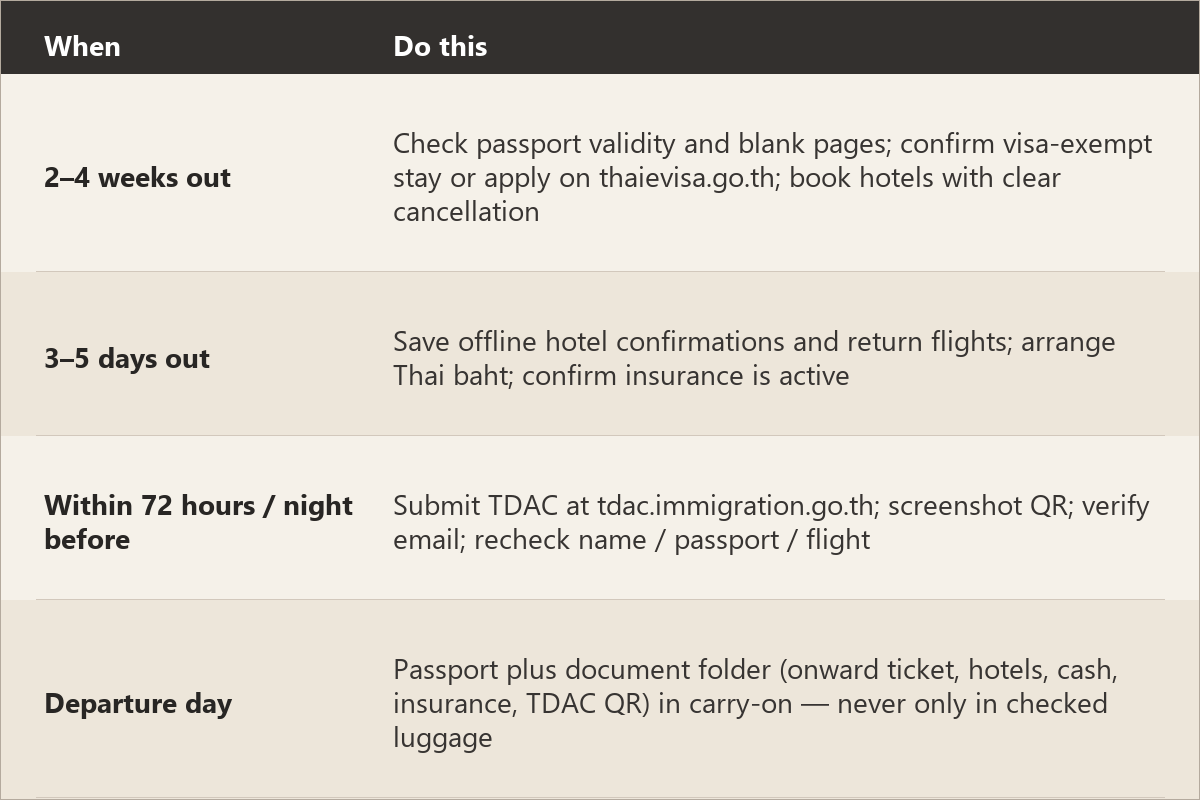
7. Your 48-Hour Checklist
8. Frequently Asked Questions
Is the TDAC the same as a Thailand visa?
No. A visa (or exemption) governs whether you may enter; the Thailand Digital Arrival Card is the arrival declaration. Visa-exempt travellers still file TDAC.
Do I need to print the TDAC?
The digital QR is accepted. Keep a screenshot. Dead phone or weak Wi-Fi should not be why you cannot show your code.
Can a family file Thailand TDAC together?
Yes—companions can be added to one declaration, or each person can file separately with their own QR.
Arriving overland from Laos or Malaysia—do I need TDAC?
Yes. TDAC applies to air, land and sea ports of entry.
Can I extend a 30-day exempt stay inside Thailand?
Extensions are handled at immigration offices under current rules. Do not plan a long holiday on the assumption that extensions are automatic or unlimited.
What happens if entry is refused?
You are usually returned on the same carrier. That is why documents sit at the top of every Thailand travel checklist—there is little room to negotiate on the spot.
Where are the official links again?
- File TDAC: tdac.immigration.go.th
- TDAC FAQ: tdac.immigration.go.th/manual/en/faq.html
- Visa / exemption lists: consular.mfa.go.th
- Thai e-Visa: www.thaievisa.go.th
- Fake TDAC warning: mots.go.th/mots_en/news/3764

9. Leave the Rest to Us
Once the paperwork is right, the remaining decisions are the pleasant ones: temple hours in Bangkok, which days the Andaman Sea runs calm, and how to link Chiang Mai to Phuket without wasting a day on logistics.
East Marvel builds private Thailand itineraries with English-speaking guides, private transfers and hotels matched to your pace. Tell us your dates and interests—we will shape the route, accommodation and ground transport, and remind you before you fly exactly which documents to have ready and when to file the TDAC.
Start from Thailand tour packages or message us on WhatsApp: +1 201 240 4890.
Entry rules change. Always confirm with the Thailand Immigration Bureau, Thai Customs, MFA Consular Affairs and your local embassy or consulate before travel.