Visa-free entry is not a plan. In 2027 many passports still enter Thailand without a tourist visa. That only answers whether you can land.
The trip works—or fails—on where you go, how many days you have, which month you pick, what you will spend, whether you travel on your own or with a private driver and guide, whether the arrival card is filed, and how you move between cities.
Western travelers rarely fail because the ticket was hard to buy. They fail when they queue at the Grand Palace at midday in hot season, book Andaman island-hopping in the wet months and wait for cancelled boats, try to cover the whole country in December at peak rates, or arrive visa-exempt and find TDAC was still required.
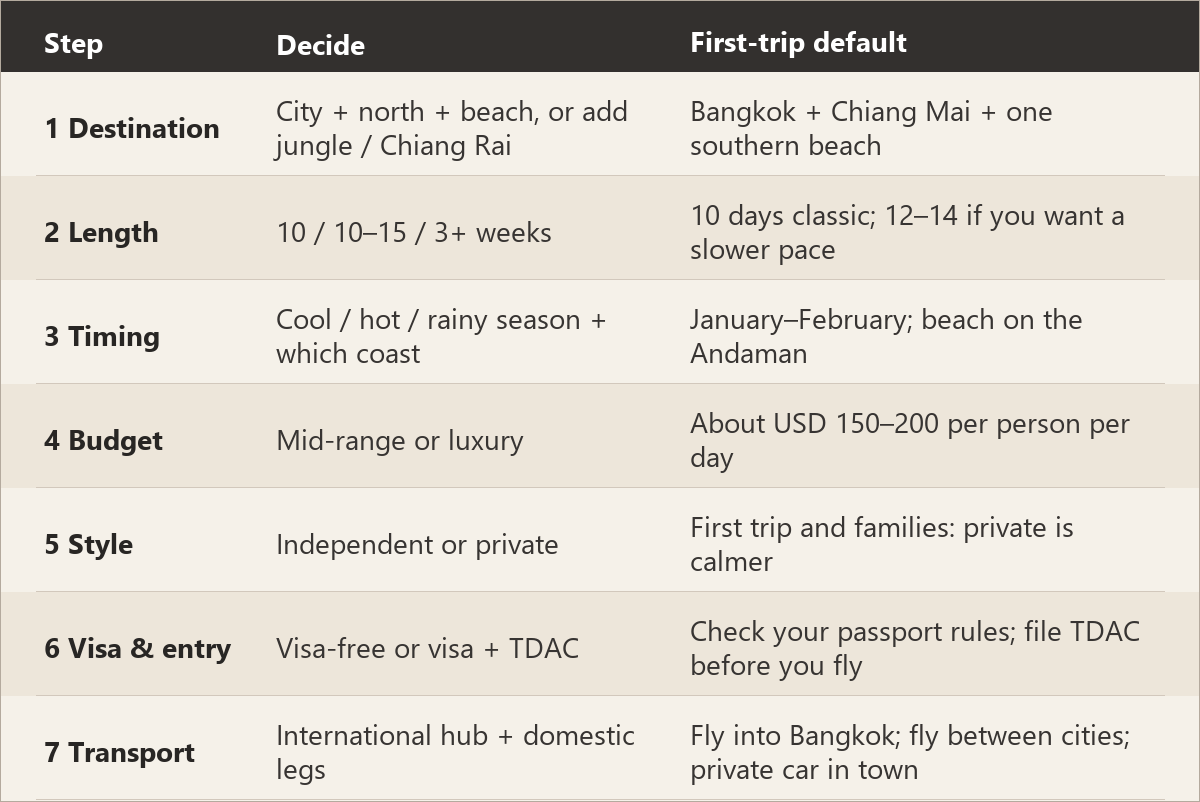
Use these seven steps in order: destination → length → timing → budget → style → visa and entry → transport. When you finish, you should be able to name one default route—and why you changed it.
A Default Answer (First Trip, About 10 Days)
Bangkok 2–3 nights → Chiang Mai 2–3 nights → one southern beach 3–4 nights.
Prefer January or February: still cool season, usually easier to book than December. Prefer an Andaman beach—Phuket, Krabi, or Lanta.
For a mid-range private trip, plan on roughly USD 150–200 per person per day. That band usually covers 4-star hotels, a private car and guide, and the meals and domestic transport listed on your itinerary. International flights sit outside it.
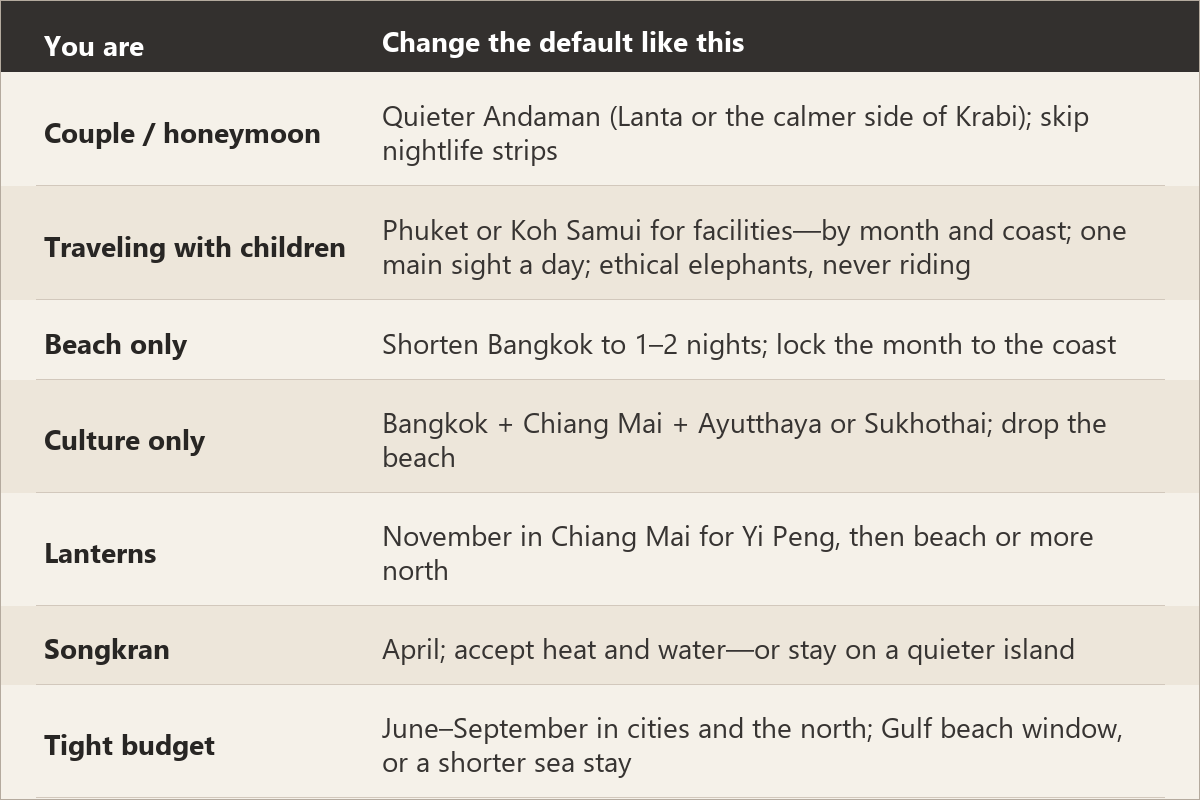
This is a starting point, not the only right trip. Traveling with children, coming for Songkran, watching the budget, or insisting on Koh Samui will change the defaults below.
Browse sample routes on our Thailand tour packages page, then move the coast to match your month.
Seven Steps at a Glance
Step 1: Where to Go — Lock the Triangle, Then Add Extras
Most first visits only need one frame:
- Bangkok — the gateway: temples, the river, street food. Two or three nights to land, adjust to the time difference, and form a first picture of the country.
- Chiang Mai — the north: temples, hills, an ethical elephant visit, a cooking class. Two or three nights. November often brings Loy Krathong and Yi Peng; align dates if lanterns are the reason you came.
- One southern beach — where you unwind. The Andaman west coast (Phuket, Krabi, Phi Phi, Lanta) and the Gulf east coast (Koh Samui, Phangan, Tao) do not share the same wet months. Choose the coast with Step 3’s month. Do not lock a hotel and then discover you booked the wrong season.
That is city + culture + beach. It holds better than ten names on a checklist.
Add these only when you have spare nights. Do not force them into an eight-day trip:
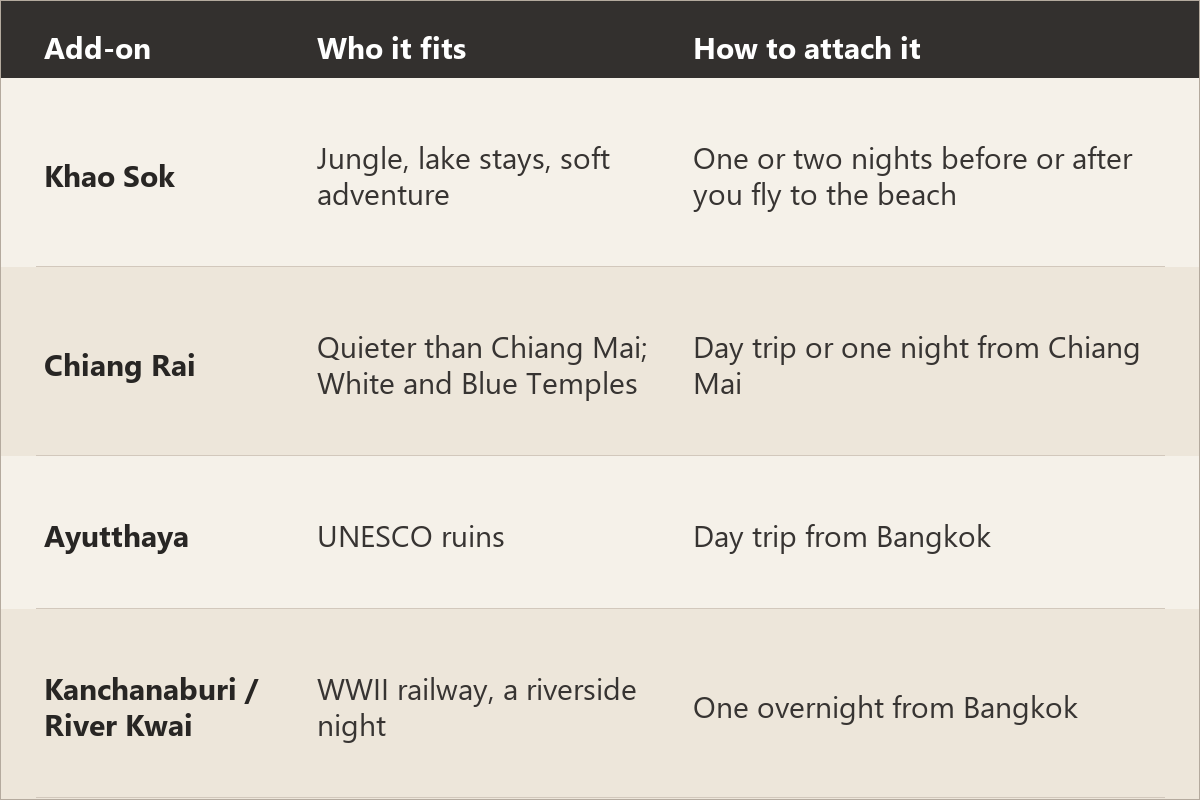
Should you add Khao Sok? If pure beach days bore you and a little heat and humidity are fine, Khao Sok often beats a second lookalike island. If the trip is a honeymoon built on sand, leave Khao Sok for next time.
City pages: Bangkok, Chiang Mai, Phuket, Krabi.
Step 2: How Many Days — 10, 14, or Three Weeks
About 10 days (classic)
Bangkok 2–3 + Chiang Mai 2–3 + beach 3–4. The rhythm is city energy, a northern slowdown, then the coast. It fits a two-week holiday including flights, a first visit, and anyone who refuses to rush.
10–15 days (deeper)
Add one block: an extra Chiang Mai night plus Chiang Rai; two nights in Khao Sok before the beach; or Ayutthaya or Kanchanaburi from Bangkok. Around 14 days, most couples and families stop feeling they only saw airports.
For a full day-by-day 14-day frame, see Thailand 2-Week Itinerary for First-Timers.
Three weeks or more
Slow the same route, or combine Thailand with Cambodia or Vietnam. Cross-border visas and flights need their own plan. Do not wedge a quick Angkor stop into an already full 10 days.
When days are short, cut in this order: a second island first, then Chiang Rai, and only last the core nights in Bangkok or Chiang Mai. Do not turn every day into a hotel move for one more name on the list.
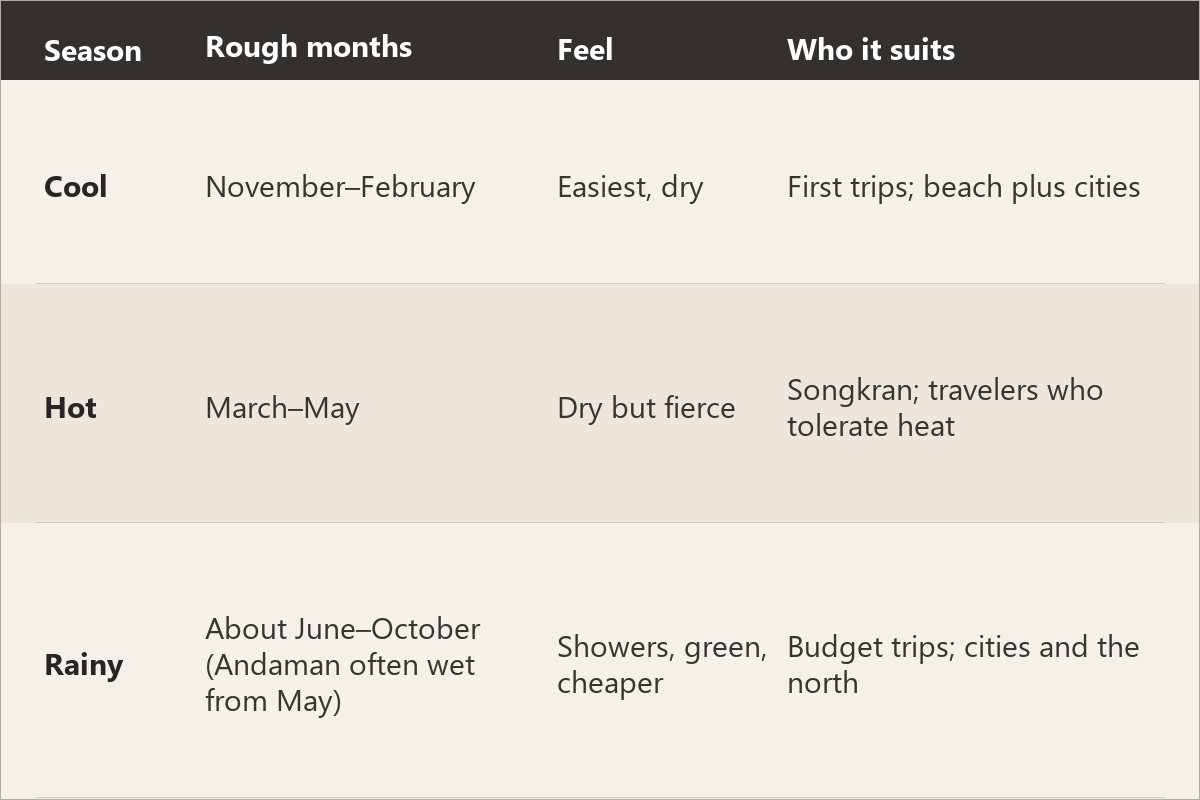
Step 3: When to Go — Three Seasons and Two Coasts
Default months: January–February. You are still in cool season. Andaman seas are often among the year’s best. New Year crowds have thinned, so booking is usually easier than in December. December’s weather is fine; it is also peak demand. Beaches need a coast choice:
- Andaman (Phuket, Krabi, Phi Phi, Lanta) — best window about November–April. Avoid locking island-hopping into the wet core around August–October.
- Gulf (Koh Samui, Phangan, Tao) — better boat months often about January–September. October–December is frequently the Gulf rain peak. Phuket in December makes sense. Koh Samui island-hopping in December means accepting unsettled weather. In June or July, a Samui route often works better than Phuket. 2027 dates worth aligning (reconfirm before you pay):
- Songkran (Water Festival) — about 13–15 April 2027. Wet, busy cities. Do not book Bangkok street days then as a quiet honeymoon.
- Loy Krathong / Chiang Mai Yi Peng — usually November; lunar dates move. Chiang Mai lantern tickets sell out early.
- New Year — Chao Phraya fireworks in Bangkok; lantern countdown in Chiang Mai. Rooms and rates follow festival rules. For the full month-by-month table, read When to Go to Thailand: Cool, Hot & Rainy Seasons.
Step 4: Budget — Set a Daily Rate Before a Trip Total
Mid-range private travel (4-star hotels, private car and guide, meals and domestic transport as listed) often lands around USD 150–200 per person per day. On a 10-day trip, that is roughly USD 1,500–2,000 per person for the ground arrangement alone—or about USD 2,000–2,800 per person when the program is fuller—before international flights. Final price moves with dates and hotels.
Luxury (5-star beach hotels, chauffeur-level service, high-end dining and experiences) often starts around USD 250+ per person per day. A 14-day private trip can sit around USD 3,500–5,000 per person. That can still look strong next to private travel in Europe or the US. It is not a street-food budget.
Working ranges for scale (they move):
- 4-star hotels: often about USD 80–150 per night; 5-star beachfront USD 250+ is common
- Domestic flights: often about USD 50–100 per person per sector
- Guided days and entries: often about USD 30–100 per person per day
- Meals: street food a few dollars; a sit-down restaurant often USD 20–40 per person
Ways to save without breaking the trip:
- Travel in May–June or September–October, or in cool season outside Christmas and New Year week
- If you must travel over New Year, Chiang Mai often has fewer compulsory gala dinners and minimum stays than the islands
- Use boutique hotels in the north; spend on the beach nights where the view matters
- Fly long distances. Do not trade a cheap bus for a ten-hour road day
International flights, insurance, visa fees, tips, and any meals or add-ons not listed usually sit outside the daily tour rate. Ask—in writing—how many breakfasts and lunches are included, and whether airport transfers are in the price.
Step 5: Independent or Private
Thailand is easy to do on your own. Grab works, domestic low-cost airlines are frequent, and English menus are common in tourist areas.
Choose private when you do not want to research Grand Palace tickets and queues yourself; when you need a genuinely ethical elephant project, not a riding show; when the family needs connecting rooms and a child’s pace; when you have only 10 days and cannot lose half a day to logistics; or when you want a long-tail sunset, a mountain blessing, or a beach dinner that has to be bookable in advance.
Independent travel saves the service fee. Private travel buys time and fewer decisions.
On a first trip with parents or children, most guests regret the stress more than the car.
Step 6: Visa, TDAC, and Entry Papers
Many passports—including the US, UK, Australia, Canada, and much of Europe—can enter for a short stay without a visa under current rules, often discussed as about 30 days. Confirm on Thai Immigration and your embassy pages before you fly. Rules change.
Visa-exempt or not, Thailand has been requiring a pre-filed TDAC (Thailand Digital Arrival Card) for many arrivals. Complete it at tdac.immigration.go.th before departure and keep the confirmation. Skipping it costs you time at the airport.
Carry:
- A passport with at least six months’ validity when possible (airlines and immigration often check)
- A return or onward ticket and hotel bookings (phone copy plus one printout is safer)
- Matching names across every booking in the group
On arrival, a local SIM or travel eSIM and Grab beat flagging down cars at the curb.
Step 7: How to Arrive and How to Move
International
From North America, common connections run via Seoul, Tokyo, Hong Kong, Taipei, or Dubai. From Europe and Oceania, nonstop flights to Bangkok are often available. The main hub is Suvarnabhumi (BKK). Don Mueang (DMK) handles many low-cost flights. Chiang Mai (CNX) and Phuket (HKT) take some international arrivals and many domestic links.
Domestic
For Bangkok–Chiang Mai and city-to-island legs, fly. Trains have charm; they are a poor way to force a same-day beach arrival onto a last departure.
In town
A private car is the calm default. Grab and Bolt work well in Bangkok, Chiang Mai, and tourist islands. Street touts and some tuk-tuks raise overcharge and detour risk. They are not forbidden. They should not be your default.
Beyond Thailand
Bangkok is the hub for Cambodia or Vietnam, but those countries need their own visa and flight plan. Thai visa exemption does not apply next door.
Change the Default by Trip Type
Safety, Food, Hotels, Language
Safety — Thailand is generally fine for families and solo travelers. Use normal sense: avoid dark empty streets at night, watch your belongings, prefer Grab or Bolt. Tourist-area scams and “gem store day trips” still exist. A private plan simply skips them.
Food — Sour and spicy are the base. Western and vegetarian options are easy in tourist areas. Choose busy street stalls with fast turnover; start mild if your stomach is cautious. Halal options exist in the south and in some cities—say so before you book.
Hotels — Standard rooms are often built for two adults plus one child. With two or more children, ask early for connecting rooms or a family suite. Island high season—especially Christmas and New Year—often means minimum stays and compulsory dinners. Ask when you request a quote.
Language — English works in tourist zones. Farther out, a guide helps. At temples, cover shoulders and knees. One light wrap beats buying a sarong at the gate.
Checklist Before You Lock the Itinerary
- Destinations fixed: Bangkok + Chiang Mai + which sea (Andaman or Gulf)
- Days match your flight days; no island-hopping the afternoon you land
- Month matches coast (especially June–October and October–December)
- Quote states whether international flights, insurance, and tips are included
- TDAC filed; passport validity enough
- Elephants, Songkran, and lanterns booked on ethical and ticket rules—not from a street pitch
Send East Marvel your travel month, party size, children’s ages, and the one place you will not cut. That beats asking for “a package” first.
East Marvel Thailand quotes are private: English coordination, hotels and car/guide as listed, domestic legs as written on the tour program. International flights and insurance are usually separate. Start from Thailand tour packages.
Questions at the Planning Stage
Can I still visit visa-free in 2027?
Many passports can. Confirm officially before you fly. Visa-free still usually means TDAC and proof of onward travel.
Is 10 days enough for a first trip?
Yes for the classic triangle. Add Khao Sok or Chiang Rai at 12–14 days.
Do I have to go to Phuket?
No. Pick the coast by month: cool season leans Andaman; if you need a beach in the rains, look at the Gulf window.
Can I go in the rainy season?
Yes. Keep boat days flexible; cities and the north still work. See When to Go to Thailand.
What does a private trip cost?
Mid-range often about USD 150–200 per person per day. Get inclusions in writing.
Note on Sources Visa rules, TDAC, and stay length follow Thai Immigration and your passport country’s advisories in real time (TDAC). USD figures are planning ranges only; season, exchange rates, and hotel class will move them.
This East Marvel guide is for 2027 trip decisions. It is not a substitute for official documents.