A lot of travelers shrink Thailand to one sentence: go in December. December is comfortable. It is also the most expensive and crowded stretch of the year.
Thailand has a cool season, a hot season (the hottest months inside the dry half of the year), and a rainy season. The Andaman coast and the Gulf do not share the same wet months.
Change the month or the coast, and the trip still works. What changes is how the days feel.
Four Things to Know Before You Book
1 . Broadly: cool season around November–February, hot season around March–May, rainy season around June–October inland and in the north (the Andaman often turns wet from May).
2 . The Gulf (Samui, Phangan, Tao) peaks later for rain, roughly October–December. January–September is more often the better window there.
3 . “You cannot go in the rainy season” is wrong. Rain is often a sharp shower. The country is greener, hotel rates are lower, and the pace is quieter. If you cannot stand a week of cancelled boats, do not put island-hopping in the Andaman’s wet core (August–October).
4 . In the north, about February–April brings agricultural smoke. March is usually the worst month for Chiang Mai’s air and for mountain views.



A Default Answer
If you need one default, take January–February. You are still inside the cool season: Andaman seas are among the year’s best, the north is dry, and Bangkok is warm without the wet-season weight. The New Year crush has already passed. Prices and crowds sit a step below December.
These are not the only months that work. For most first trips, they are the least likely to go wrong.
Start from a Bangkok–Chiang Mai–beach sample, then move the coast to match your month.
For a classic first route in that window, browse our Thailand tour packages.

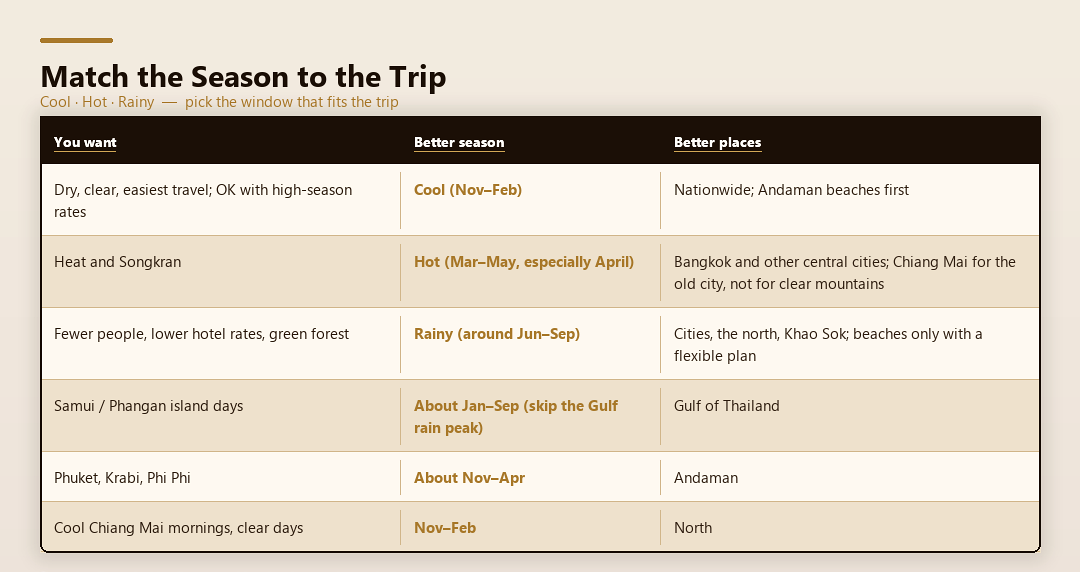
Match the Season to the Trip
Use this shortlist when you choose a season. City pages: Bangkok, Chiang Mai, Phuket, Krabi.
- Dry, clear, easiest travel; OK with high-season rates → Cool (Nov–Feb) → Nationwide; Andaman beaches first
- Heat and Songkran → Hot (Mar–May, especially April) → Bangkok and central cities; Chiang Mai for the old city, not clear mountains
- Fewer people, lower hotel rates, green forest → Rainy (around Jun–Sep) → Cities, the north, Khao Sok; beaches only with a flexible plan
- Samui / Phangan island days → About Jan–Sep (skip the Gulf rain peak) → Gulf of Thailand
- Phuket, Krabi, Phi Phi → About Nov–Apr → Andaman
- Cool Chiang Mai mornings, clear days → Nov–Feb → North
Prefer the table photo in the next section if you uploaded it; the list above is the same shortlist in text form.
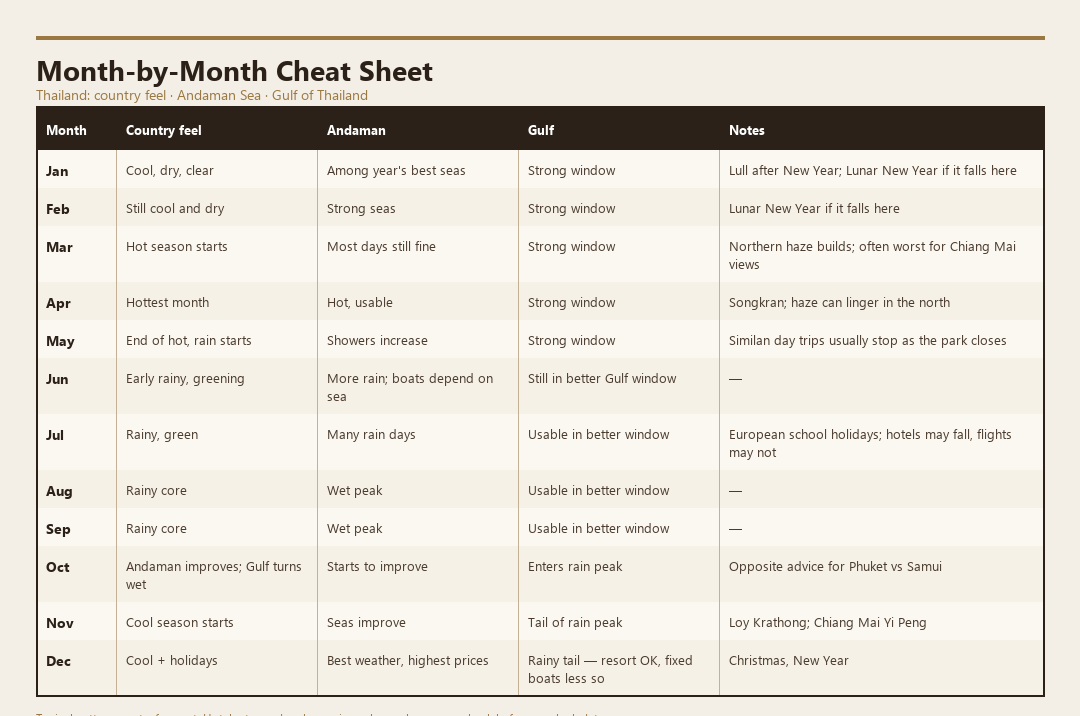
Month-by-Month Cheat Sheet
Price band for hotels: high ≈ December level; shoulder in the middle; low often 30–50% below high season (festival weeks aside). Flights do not follow the same curve.
European school holidays in July–August, Christmas and New Year, and Lunar New Year (late January or February) can push airfares — and hotels with them — back up.
Check live rates before you lock anything. Use the month table photo below for a quick scan.
Feel by Season in Four Cities
These are typical ranges, not a forecast.
Samui’s cool-season rain-day count is pulled up by November and December; January and February are drier. Samui’s wettest months sit partly outside the June–October column.
Read the city table photo with that Samui caveat in mind.
Cool, Hot, and Rainy — How the Days Feel
Cool season (about Nov–Feb) is the safest default for a first trip. November settles the Andaman (and often brings Loy Krathong / Yi Peng). December stacks the best Andaman seas on holiday demand — expensive and crowded; Samui is still in its rainy tail. January–February keep cool-season weather after New Year, usually with calmer rates than December.
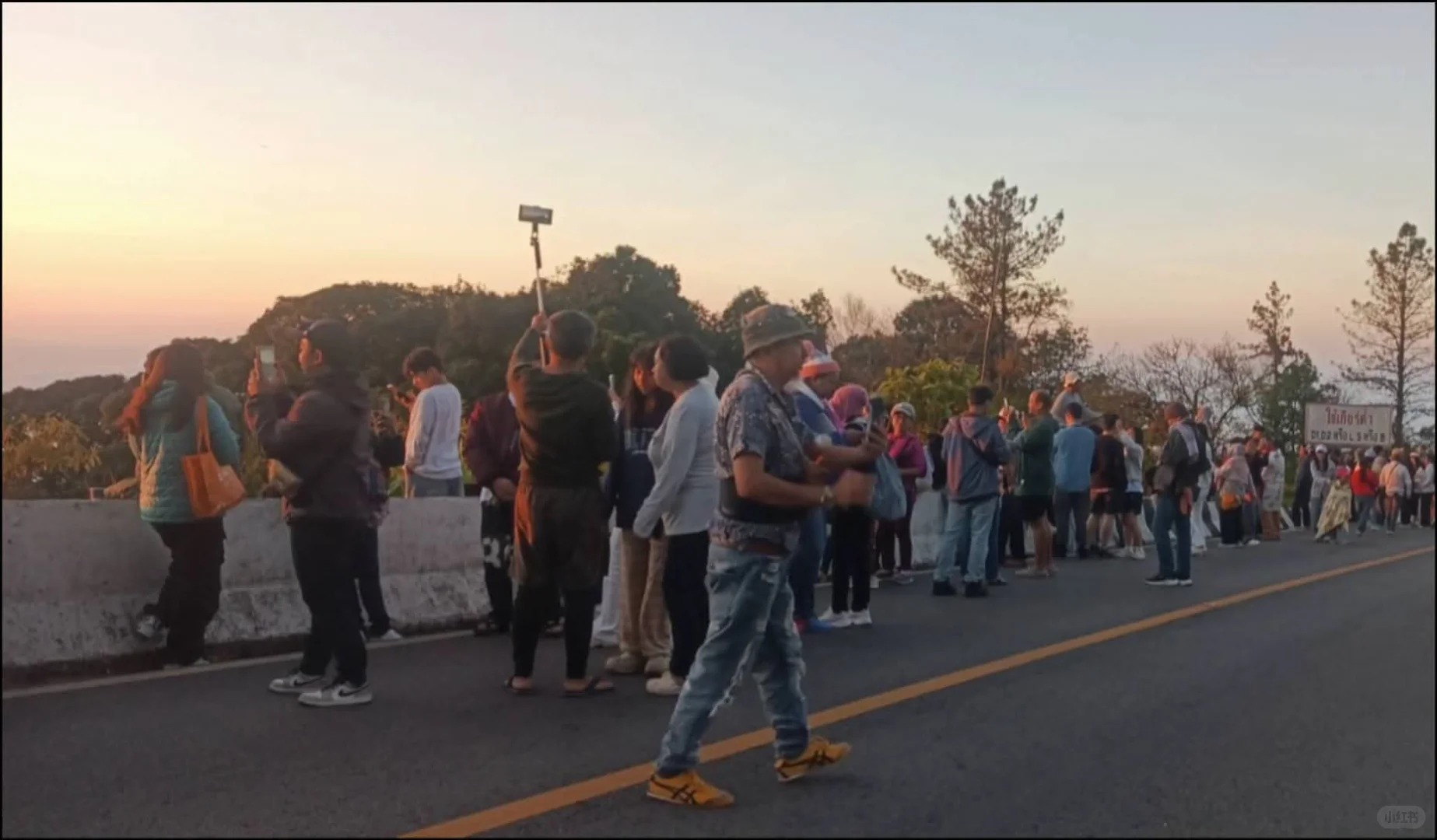
Hot season (about Mar–May) stays mostly dry, but heat climbs toward 35°C in Bangkok and Chiang Mai. February–April bring northern burning-season smoke; March is usually worst for mountain views. April is Songkran — book the city as a festival. May starts Andaman showers and usually closes Similan day trips from mid-month. Sightsee early and late.
Rainy season (about May/June–October) is often hard, short showers. The Andaman is wettest around August–October; the Gulf peaks around October–December. June–July are greener and quieter, but July–August European holidays can keep flights expensive. October can mean opposite advice for Phuket and Samui.
Use the rainy window for hotel value and city days — not for daily Andaman snorkeling you cannot move.


Why the Two Coasts Are Not the Same
This is why Thailand is not a December-only country.
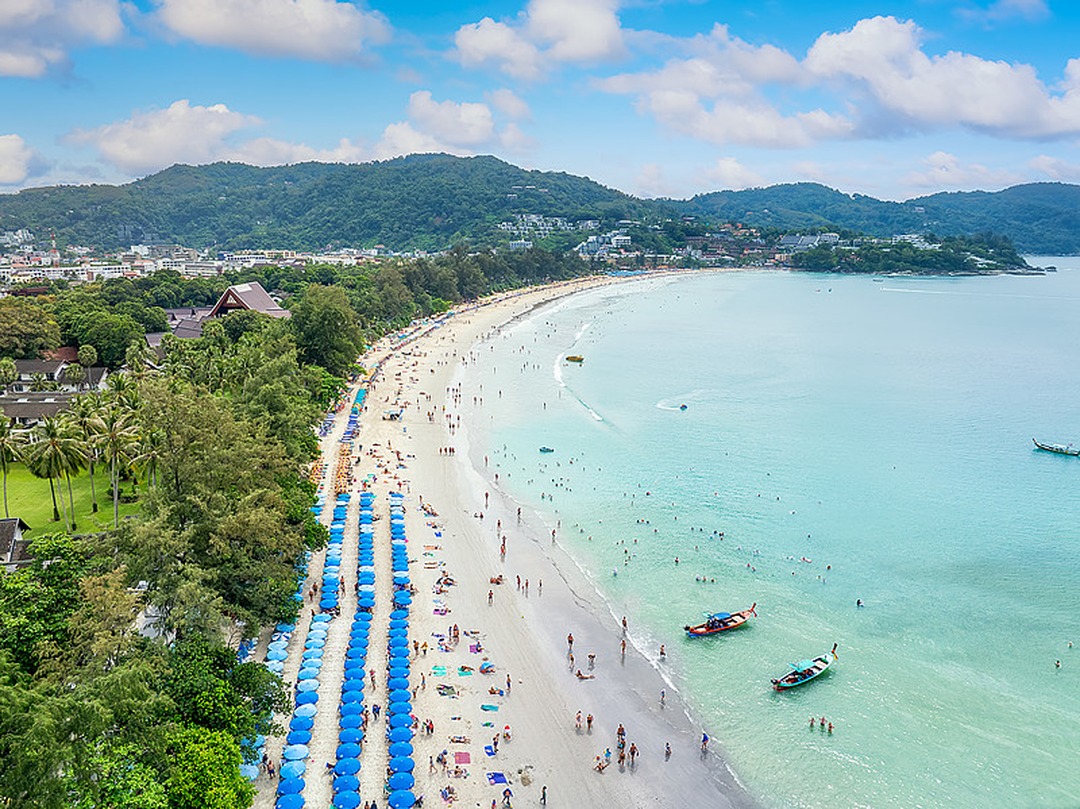
Andaman Sea (Phuket, Krabi, Phi Phi, Lanta): best window roughly November–April; wet roughly May–October. Similan National Park is usually closed from about mid-May to mid-October. For postcard-calm water, put island days in the cool season through early hot season.
Gulf of Thailand (Samui, Phangan, Tao): better boat months often fall around January–September; October–December brings more Gulf rain and swell. Phuket in December makes sense. Samui island-hopping in December means accepting the rainy tail. In June or July, Samui often fits better than Phuket.
The center and north do not hinge on which sea you face. Use cool for comfort, hot for early-and-late days, rain for cities with a shower plan.
From February through April, add haze before you promise northern mountain views.


Pick the Month by the Trip
- First trip, 8–10 days, Bangkok + Chiang Mai + one beach: prefer November–February with the beach on the Andaman. Tight hotel budget: May or September, with a flexible beach plan.
- Cities and culture only: any month works; cool season feels best. April is for Songkran. June–September buys space and lower hotel rates. Chiang Mai clear days are November–February; in March–April plan on haze.
- Andaman beach only: November–April. December–January is steadiest and dearest in holiday weeks.
- Samui / Phangan / Tao only: aim for January–September. Skip the Gulf’s October–December peak unless cancelled boats are acceptable.
- Save on hotels, shoot green: June–September in cities and the north; inside that window the Gulf is the more coherent beach bet (July–August flights from Europe may still be high).
Festivals that should change the month you pick:
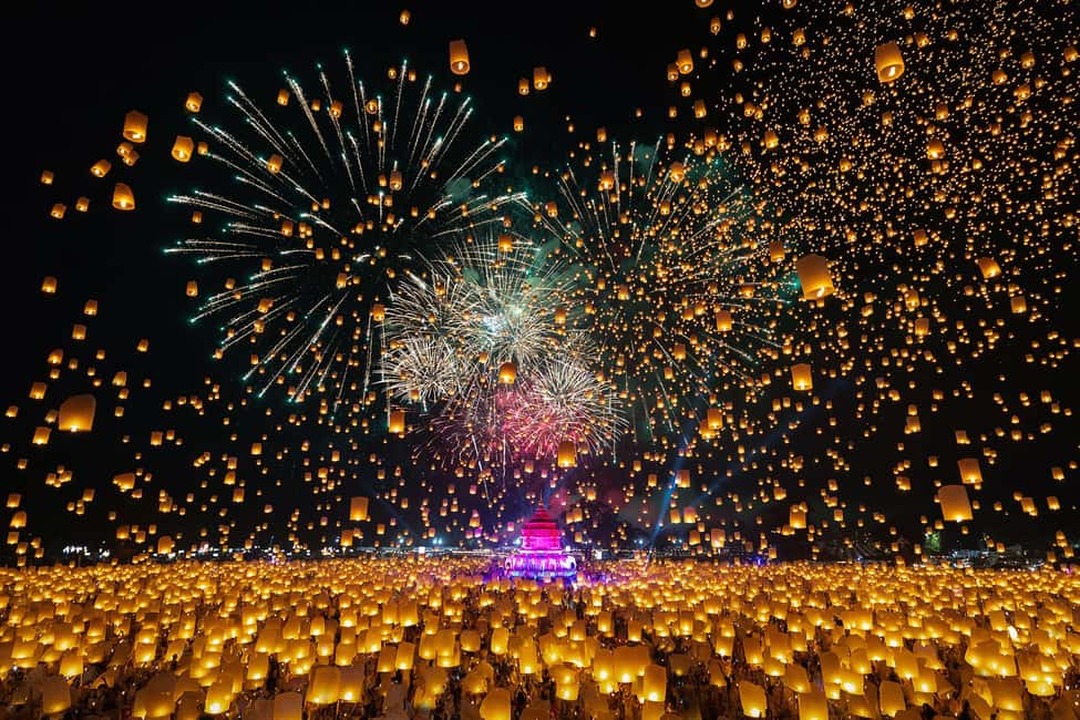
- November — Loy Krathong and Chiang Mai Yi Peng
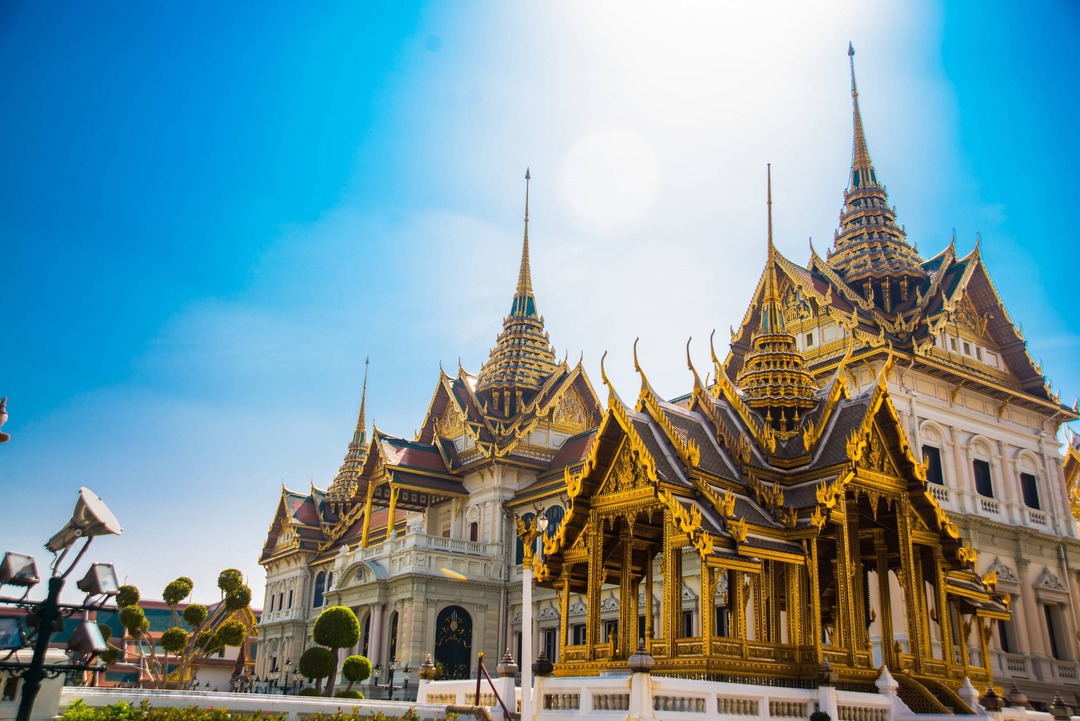
- 5 December — Father’s Day candlelight (Sanam Luang by the Grand Palace is a focus)
- 31 December — New Year (ICONSIAM fireworks on the Chao Phraya; Tha Phae Gate countdown in Chiang Mai)
- Around 13–15 April — Songkran
- Lunar New Year — late January or February; hotels tighten for a few days even inside an easier month



What to Pack, Myths, and Next Step
What to pack
- Cool season: short sleeves in the south by day; a light jacket for northern mornings and evenings.
- Hot season: very light fabric, sun protection, a hat. In the north February–April, a mask helps more than another shirt if smoke is bad.
- Rainy season: quick-dry clothes, a light rain shell, grippy sandals; dry bags for phones.
- Temples year-round: one wrap that covers shoulders and knees beats buying a sarong at the gate.
Myths
- “You cannot visit in the rainy season.” You can — fewer fixed boat days, more flexibility, usually better hotel rates.
- “Dry season means cool.” Dry season includes the hot months. March–May is dry and hot, not December comfort; in the north it is also haze season.
- “December is good for island-hopping everywhere.” The Andaman, yes. The Gulf is less reliable.
- “Only December works.” January–February is often calmer for Bangkok–Chiang Mai. Samui can fit better in July than December. Phuket in March still works. Chiang Mai in March can be broken by smoke.
Thailand has three seasons and two coasts. Get both right, and most months have a route that holds.
For most first-timers: look at January and February before you lock December.
For a private route that matches your month, send dates, travelers, and preferred coast — or start from our Thailand tour packages.